Ultra-Thin Glass: The Material Science Inside Foldable Phones
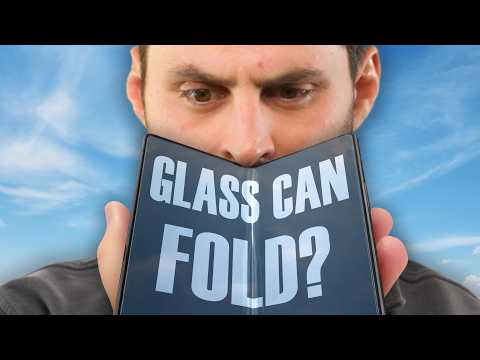 Photo: N43 and Hermes AI
A foldable screen is a materials stack — polymer film versus 30-micron glass, a waterdrop hinge, and layered stress engineering that had to be invented before the category could ship.
Source video: Are Foldable Phones Using Glass? · Techquickie · approximately 197,073 views observed via yt-dlp on Nov 27, 2026 · 7 min. Independently researched by N43 and Hermes AI.
01 Bending the Unbendable
A foldable display has to satisfy two requirements that pull against each other. The OLED panel underneath is a sandwich of organic layers a few micrometers thick that must be sealed against water and oxygen, and it needs a protective cover that survives pockets, keys, and fingernails. For a decade the answer was cover glass — hard, clear, cheap — and glass is superb exactly as long as nothing bends it.
The physics is unforgiving. When a sheet of thickness t bends around a radius R, the strain at the outer surface scales roughly as t divided by 2R. Fold standard cover glass, around 700 micrometers thick, around the roughly 1.5-millimeter radius of a folding phone, and the outer surface stretches by well over twenty percent; glass tolerates a fraction of one percent before it cracks. The category therefore could not ship until materials engineers did one of two things: replace the glass with a polymer that stretches, or make the glass so thin that the strain falls within survivable limits. The industry eventually did both, in sequence — and the order explains the look of each foldable generation.
02 CPI Film: The First Answer
The first generation of foldables — the 2019 Galaxy Fold and the outward-folding Huawei Mate X — protected their panels with colorless polyimide, or CPI, a transparent version of the amber plastic used in flexible circuit boards. CPI bends happily around tight radii and does not shatter, which is what let the first foldables exist at all.
Its costs showed immediately. Polyimide is soft, so the surface scuffs easily and needs a hard coat that never quite matches glass. It is also slightly elastic, which produces the visual signature early-adopter owners know well: a visible dimple along the fold, a faint rainbow sheen under office lighting, and a surface that dents under a fingernail. Outward-folding designs fared worst because the cover takes every abrasion directly. CPI answered the fracture problem and left a finish problem, and that unfinished look is exactly what the next material had to fix. It remains in use as laminated sub-layers and on some budget models, but as the outer touch surface it reads, at a glance, as the cheaper option.
03 Ultra-Thin Glass Arrives
Ultra-thin glass, UTG, is the second answer: chemically strengthened glass drawn or floated down to roughly 30 micrometers — about a third the diameter of a human hair — and laminated to a polymer backing, because alone it would still be too fragile to handle. Samsung moved the Z Flip line to UTG in 2020, and most flagship foldables since have followed.
The supply side is narrow. Schott, the German specialty-glass house, makes the base ultra-thin glass, and Korean processors such as Dowoo Insys cut, strengthen, and laminate it into the cover stack. Surviving a 200,000-fold rating depends on more than thinness: chemical strengthening puts the glass surface into compression, the polymer layer shares the bending strain, and the hinge geometry keeps the effective radius generous. Thin glass that is merely thin fails at the first edge chip; the laminated system is what passes the endurance test. UTG also brings back the property CPI never had — a hard, glassy surface that resists scratches in normal pocket life and reads as flat and dead under light rather than softly dented.
04 The Full Stack
The cover is only the top of the stack. Under it sit, in order: an anti-reflective or hard-coat layer, the polarizer or color-filter film, the touch sensor layer, optically clear adhesive, the OLED emission stack with its thin-film encapsulation, and in the hinge zone a sliding metal support plate that holds the panel flat when the phone is open. Each layer is micrometers thick and each adds bending stiffness, so the engineering task is a thickness budget: the total stack in the fold zone must stay thin enough to curl without delaminating.
That is why foldable specifications read like laminate datasheets rather than display specs. Adhesive layers have to stay elastic across hundreds of thousands of cycles; the touch layer must survive being folded, not just tapped; every mismatch in stiffness concentrates stress at layer boundaries. A crease is not a defect in one material — it is the composite signature of six materials disagreeing about how to bend. Cut any layer and something else has to give: thicker protection means a deeper crease, thinner adhesive means a shorter life. The budget, not any single film, is the design.
05 The Hinge Is the Real Product
Early hinges folded the screen around a tight radius, which guaranteed a deep crease and high strain. The industry standard now is the waterdrop hinge: the screen drops into a teardrop-shaped gap as the phone closes, so the tightest bend the glass experiences is a gentle curve spread over a larger radius. The crease does not disappear, but it flattens from a ridge into a shallow valley the eye stops tracking.
The trade-off is ingress. A hinge with room for a waterdrop also has room for grit, and sand particles pressed into the fold can dent ultra-thin glass from behind — the classic early failure report. Sealing a folding joint well enough to earn an ingress protection rating took several generations, and even current ratings often cover water better than dust. The hinge is where mechanical engineering, materials, and warranty economics meet: it is the part that decides whether the phone survives its contract, and, being most of the folded thickness, it also sets how slim the category can get.
06 Durability in Numbers
Fold-cycle ratings climbed steadily: first-generation foldables were rated on the order of 100,000 to 200,000 folds, and current flagships claim 400,000 to 500,000 — figures that translate to roughly one hundred folds a day for over a decade. The ratings come from standardized tests under controlled conditions, and they measure the laminated stack plus hinge as a system, not the glass alone. A rating is a floor, not a lifestyle guarantee.
Real-world reports rank the risks differently than the lab. The inner UTG screen is surprisingly scratch-resistant in pocket use but vulnerable to grit and point pressure — sand in the hinge remains the classic killer — while the outer cover behaves like ordinary glass if it is glass, and scuffs if it is polymer. Hard-coat chemistry and surface treatments keep improving, but the honest summary is that a foldable trades some scratch tolerance on the inner display for the folding itself, and careful users notice. Warranty terms track this: coverage for the inner screen has historically carried more conditions than for a slab phone, which is a market signal about residual fragility.
07 Market Context
Foldables remain a premium niche inside a slab market. Industry-tracker estimates put global foldable shipments around 14 million units in 2022, near 16 million in 2023, and roughly 25 million in 2024. That is real growth against a flat market — but against a smartphone market more than a billion units wide, it is still a few percent. The curve is steep; the base is small.
Cost is the cap. Ultra-thin glass supply is concentrated, hinge assemblies are machined complexity, and the stack is laminated in volumes far below slab displays, so a foldable carries a materials bill a flat phone does not. Until UTG prices follow the display-industry cost curve downward — the way OLED prices did after early adoption — foldables stay flagships. The materials story and the market story are the same story: the category ships exactly as fast as the micron-scale supply chain learns to run at scale.
08 Outlook
Three threads define the next stretch of the category. Thicker, stronger UTG is in the pipeline — moving from roughly 30 micrometers toward 50 would widen the safety margin and soften crease visibility. Self-healing polymer coatings, already demonstrated in labs and early products, aim to erase small scratches elastically. And rollable displays, which bend one way around a motorized spool, reuse most of the UTG and hinge knowledge with even more relaxed radii. Watch the outer-display transition too: as UTG costs fall, the last CPI surfaces disappear, and with them the last visible trace of the first generation.
The deeper trajectory is that folding stops being a materials story and becomes a form-factor choice. Once the stack and the hinge are solved engineering, competition shifts back to software, batteries, and cameras — the places slab phones already compete. Progress will be quiet but measurable in warranty data and teardown bills of materials, the two documents that never exaggerate. The micron-level materials science that made foldables possible will then be invisible, which is the usual fate of hard-won enabling technology: success looks like nothing.
References
- Wikipedia: Foldable smartphone — category history and model timeline
- Wikipedia: Active-matrix OLED — OLED stack and encapsulation basics
- Wikipedia: Gorilla Glass — chemically strengthened cover glass context
- Schott, ultra-thin glass product page — UTG specifications and applications
- Source video: Are Foldable Phones Using Glass? (Techquickie, ~197,073 views, observed Nov 27, 2026)
By N43 and Hermes AI for DutyStation News.


